
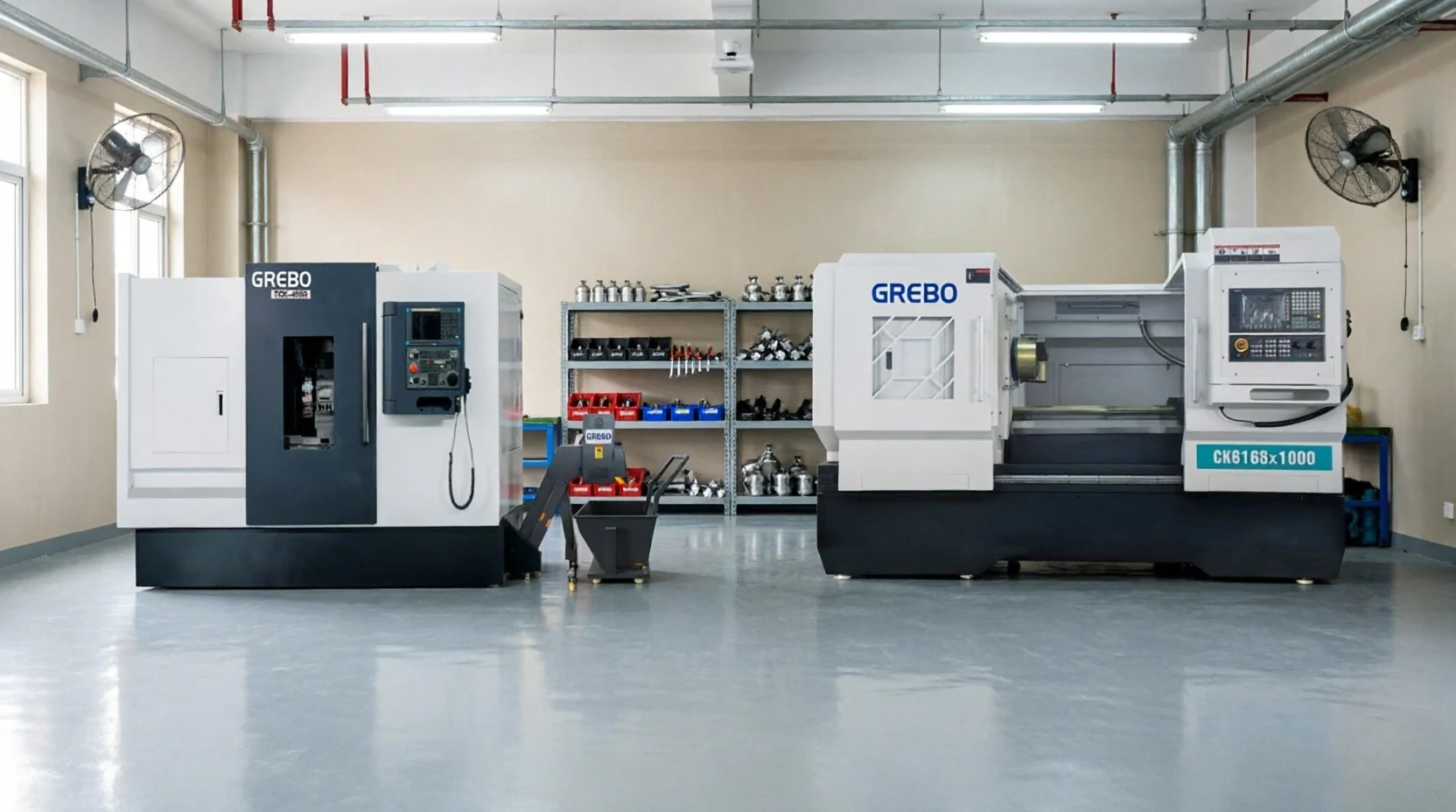

Ask ten machinists which bed design is “better” and you’ll get ten confident answers that contradict each other — because the honest answer isn’t about which lathe is better, it’s about which one matches the part sitting on your desk. The flat bed vs slant bed CNC lathe question comes down to geometry, chip behavior, and how much your parts weigh, not brand loyalty or which machine looks more modern on the showroom floor.
Lean toward Flat Bed if…
You’re turning long shafts, large-diameter castings, or heavy unbalanced parts where raw structural mass and swing capacity matter more than cycle speed.
Lean toward Slant Bed if…
You’re running small-to-medium parts at volume, need fast tool changes, and want chip evacuation that doesn’t depend on an operator remembering to sweep.
What Actually Separates These Two Bed Designs
A CNC lathe’s bed is the structural spine the headstock, carriage, and guideways all bolt onto — get the bed wrong for the job and no amount of spindle horsepower fixes it. Among all the CNC lathe bed types a shop might consider, flat and slant account for the vast majority of real-world purchases. A flat bed keeps its guideways parallel to the floor, the same layout a manual lathe has used for a century. A slant bed tilts those guideways to an incline, most commonly 30° or 45°, occasionally steeper.
That single angle change cascades into almost every practical difference in the flat bed vs slant bed CNC lathe comparison, starting with the one machinists notice first: what happens to the chips.
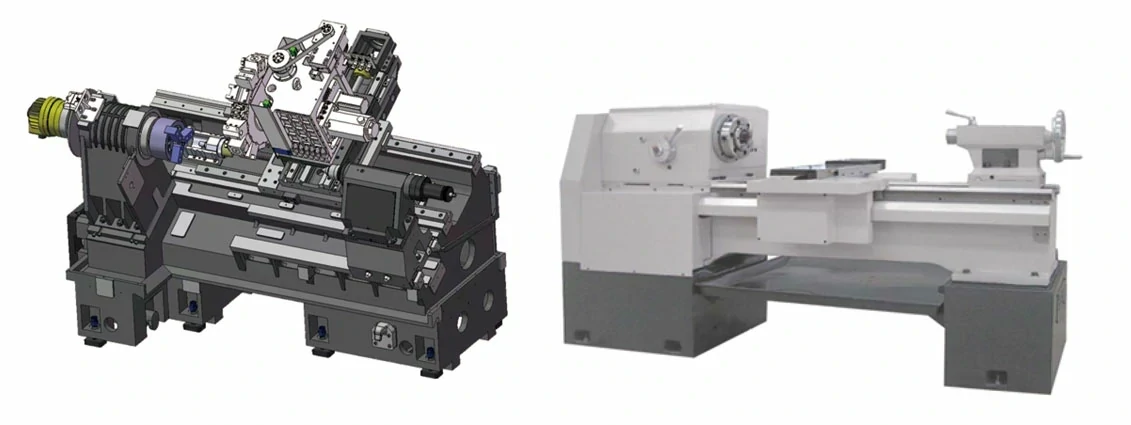
Flat Bed CNC Lathe: Where Mass Does the Work
A flat bed lathe’s horizontal guideways sit level with the floor, giving the casting a wide, low footprint. That width is the whole point — it puts more cast iron directly under the cutting zone, which is exactly what you want when the workpiece itself is heavy and unbalanced.
- Swing capacity: flat beds generally scale to much larger diameters than a comparably priced slant bed frame, since the width of the casting isn’t constrained by an angled profile.
- Low-speed torque: the structure holds up well under high cutting forces at low rpm, which is exactly the load profile of roughing a large casting or forged flange.
- Setup flexibility: the open, horizontal working area makes it easier to fit steady rests, custom fixtures, and oversized chucks without fighting the machine’s geometry.
The trade-off is chip management, and it’s usually the deciding factor once buyers get past the flat bed vs slant bed CNC lathe question in the abstract and start looking at their actual production floor. On a horizontal surface, chips don’t have gravity working in your favor — they land on the bed and stay there until coolant flow or an operator clears them. For heavy roughing passes on cast iron or steel, that’s a manageable routine. For unattended, high-volume production, it becomes the bottleneck.
Slant Bed CNC Lathe: Where Gravity Does the Work
Tilt the same guideways to an incline and chips no longer need help leaving the cutting zone — they fall straight down into the conveyor as they’re formed. That’s the headline benefit, and it’s well documented across the industry: chip evacuation is treated as a core design consideration in modern turning, not an afterthought, as Cutting Tool Engineering’s overview of turning fundamentals makes clear.
- Continuous chip clearance: gravity keeps the slideways and ballscrew cleaner over a shift, which reduces the abrasive wear that shortens machine life on high-utilization lines.
- Shorter tool-to-spindle distance: the angled layout brings the turret closer to the workpiece centerline, which tightens up rigidity for the diameter range these machines are built for.
- Operator sightlines: the inclined enclosure gives a clearer view into the cutting zone than reaching over a flat, horizontal bed.
- Automation-friendly footprint: the compact frame pairs naturally with bar feeders, gantry loaders, and robotic cells, which is a big reason slant beds dominate high-volume turning cells today.
None of that comes free. Rigidity in any turning setup is a negotiation between geometry and mass — a point Modern Machine Shop’s analysis of lathe geometry makes well: push a slant bed frame beyond the diameter and weight it was designed for, and the same angle that helps chip flow starts working against structural stability.
Flat Bed vs Slant Bed CNC Lathe: Side-by-Side Comparison
| Factor | Flat Bed | Slant Bed |
|---|---|---|
| Bed angle | 0° (horizontal) | Typically 30° or 45° |
| Chip evacuation | Relies on coolant flow or manual clearing | Gravity-assisted, largely self-clearing |
| Best workpiece size | Large-diameter, heavy, or unbalanced parts | Small-to-medium parts, disc and flange geometries |
| Speed profile | Low-speed, high-torque roughing | Medium-to-high-speed precision turning |
| Footprint | Wider, needs more floor space | More compact for the same work envelope |
| Automation fit | Possible, but less common at high volume | Strong fit for bar feeders and robotic cells |
| Typical cost tendency | Generally lower entry cost for large-swing models | Commands a premium tied to automation compatibility |
Matching Your Workpiece to the Right CNC Lathe Bed Type
The most reliable way to settle a flat bed vs slant bed CNC lathe decision is to stop thinking about the machine and start with the part. Among the different CNC lathe bed types, the right one is almost always obvious once you know the diameter, weight, and batch size you’re actually running.
Disc parts, flanges, valve bodies
Short axial length, wide face diameter — the textbook slant bed application. Chip clearance during long facing passes is where slant beds earn their keep.
Long shafts
Once length-to-diameter ratio climbs, bending forces between chuck and tailstock become the limiting factor. Flat bed frames with steady-rest support handle this more predictably.
Heavy castings and forgings
Large, out-of-balance stock above roughly Ø500mm needs the raw mass of a flat bed frame to damp vibration during the first roughing pass.
High-volume small parts
Automotive fittings, medical components, and similar batch work favor the slant bed’s speed, chip control, and compatibility with bar feeders.
If your part mix genuinely spans both categories, it’s worth talking through your drawings before committing — our team works from actual part prints when helping customers choose between our flat bed CNC lathe and slant bed CNC lathe lines, since the two share our CNC lathe category but serve genuinely different production realities. Shops running large valve or flange work alongside our energy industry customers tend to lean flat bed, while high-mix precision parts for medical and automotive production usually land on slant bed.
Vetting a Slant Bed CNC Lathe Manufacturer
Bed geometry is only half of any flat bed vs slant bed CNC lathe purchase — the other half is who built the casting. A rushed or under-aged casting will drift out of tolerance regardless of whether it’s angled at 30° or sitting flat, so when you’re evaluating a slant bed CNC lathe manufacturer, ask specifically how the bed castings are aged and stress-relieved before finish machining, not just what the headline spindle speed is. The same applies on the flat bed side — swing capacity on a spec sheet means little if the casting can’t hold it under load.
A few questions worth asking before you commit to either bed type:
- What guideway type is used — box ways, linear rails, or a hybrid — and how does that match your expected duty cycle?
- Can the manufacturer share reference installations running a similar part family to yours?
- What’s the realistic lead time and spare parts support for your region?
You can read more about how our factory approaches these questions on the about us page, or browse our full CNC machining solutions lineup if lathes are only part of what you’re sourcing.
Not Sure Which Bed Type Fits Your Parts?
Still weighing the flat bed vs slant bed CNC lathe decision for your shop? Send us your part drawing, diameter range, and batch size — we’ll tell you honestly whether a flat bed or slant bed lathe is the better fit, even if that means pointing you toward the less expensive option.
Talk to Our TeamFAQ
Is a slant bed CNC lathe always more precise than a flat bed?
Not automatically. In the flat bed vs slant bed CNC lathe comparison, slant beds tend to hold tighter tolerances on small-to-medium parts because of shorter tool overhang and cleaner chip flow, but a well-built flat bed will out-perform an undersized slant bed on large, heavy work every time. Precision is a function of matching frame to part, not bed angle alone.
Can one shop realistically run both bed types?
Yes, and many do. Shops with a genuinely mixed part mix — say, flanges and valve bodies alongside occasional long shafts — often keep one of each rather than compromising on a single machine that handles neither job particularly well.
Does bed angle affect maintenance requirements?
Indirectly, yes. Slant beds generally need less manual chip clearing since gravity handles most of it, but the chip conveyor itself becomes a wear item that needs regular attention. Flat beds put more of that burden on coolant flushing routines and operator discipline.
Why do slant bed lathes typically cost more than flat bed models of similar swing?
A large part of the premium comes from the casting itself — building a true angled bed with adequate rigidity uses more material and more complex tooling than a horizontal casting of the same capacity, and that cost carries through to automation-ready features like enclosed chip conveyors and bar feeder interfaces that slant bed buyers typically expect as standard.