

Walk onto any shop floor and you’ll hear the same complaint from buyers who rushed their purchase: the machine runs fine, it just isn’t the right machine for the work coming through the door. Learning how to choose a CNC machining center is less about finding the “best” model on a spec sheet and more about matching a machine’s structural kinematics to your parts, your volumes, and your floor. Get that match wrong and you’ll spend the next five years fighting the equipment instead of using it.
Here’s the short version of how to choose a CNC machining center, before we go step by step: start from your part geometry, not the catalog. Flat, single-face parts point toward a vertical machining center. Multi-sided box parts running in volume point toward a horizontal. Complex contoured or undercut geometry points toward 5-axis. Oversized parts point toward a gantry. Once geometry narrows the field, layer in production volume, floor space, control system, and — just as important — the track record of the CNC machining center manufacturer behind the machine.
How to Choose a CNC Machining Center: A 5-Step Framework
Most buyers start by comparing horsepower and travel distances. That’s backwards. Work through these five questions first, and the spec comparison becomes a lot shorter. In practice, how to choose a CNC machining center almost always comes down to these five decisions, in this order.
- Define the part, not the machine. Pull your five most-machined parts and five parts you expect to win in the next two years. Note material, tolerance, number of faces that need machining, and whether any feature requires an undercut or compound angle.
- Set a realistic production volume. One-off prototypes and 500-piece batches call for very different automation levels. Be honest about where your order book is actually headed, not where you hope it goes.
- Map your floor, not just your budget. Ceiling height for crane access, three-phase electrical capacity, compressed air quality, and slab load rating rule out machines before price ever does.
- Decide your control ecosystem. FANUC, Siemens, and Mitsubishi dominate the market for good reason, but switching control platforms mid-fleet adds training overhead. Match new equipment to what your programmers already know.
- Vet the manufacturer, not just the machine. Spare parts lead time, applications support, and warranty response separate a good five-year ownership experience from a painful one. This is where most buyers under-invest their research time — and it’s especially true when sourcing from a CNC machining center manufacturer in China, where factory visits aren’t always practical and due diligence has to happen mostly on paper.
Types of CNC Machining Centers, and Where Each One Wins
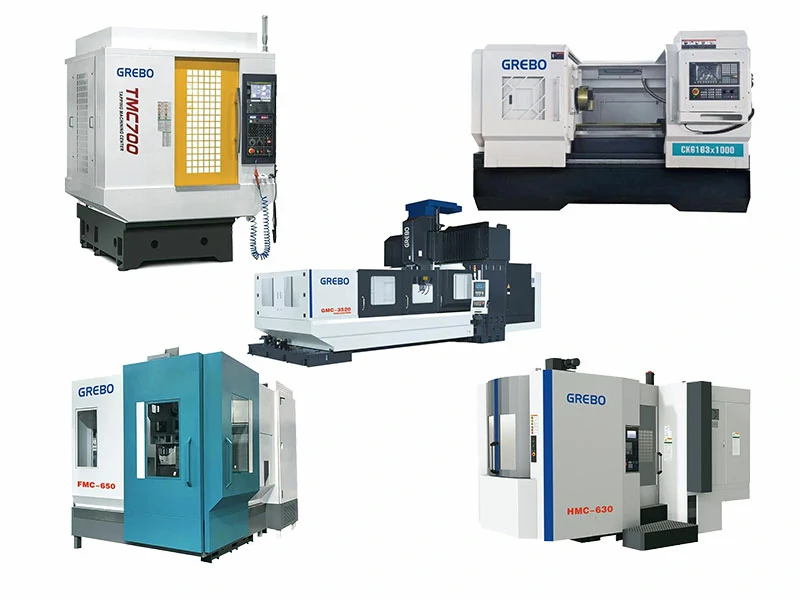
There is no single best configuration — only the right one for the geometry and volume in front of you. At this stage, how to choose a CNC machining center comes down to matching one of five structural layouts to your part, so here’s how the main types of CNC machining centers actually differ on the shop floor, not just on paper.
Vertical Machining Center (VMC)
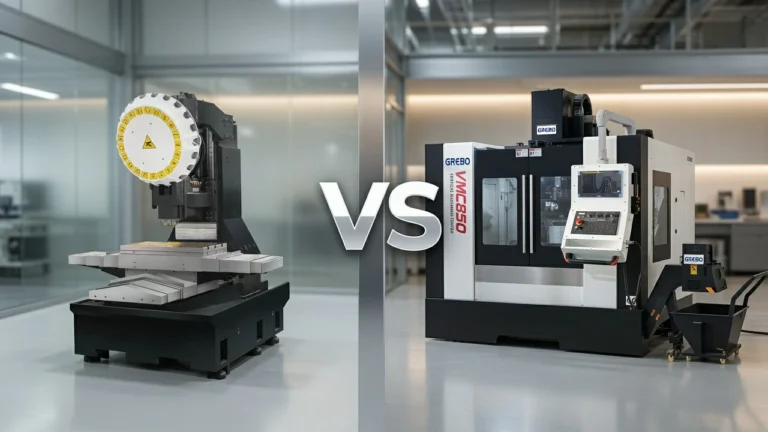
The vertical machining center is where most shops start, and for good reason. A top-down spindle gives operators direct sightlines to the cut, gravity helps clamp flat stock, and the footprint is small enough for a job shop with mixed work. Where it struggles is deep-pocket chip evacuation and any part that needs more than one face machined without a re-fixture.
Horizontal Machining Center (HMC)
Once volume climbs and parts need multiple faces cut in one clamping, a horizontal machining center earns its higher price tag. Chips fall away from the cut by gravity instead of packing into pockets, and a rotary B-axis with tombstone fixturing lets you machine four sides without touching the part. Automotive housings and hydraulic valve bodies are the classic use case.
5-Axis Machining Center
When a part has a compound angle, an undercut, or a contoured surface that would otherwise need three or four setups on a 3-axis machine, a 5-axis machining center collapses that into one operation. The trade-off is programming complexity — you need CAM software and an operator comfortable with simultaneous toolpaths, or the collision risk goes up along with the machine cost.
Gantry Machining Center
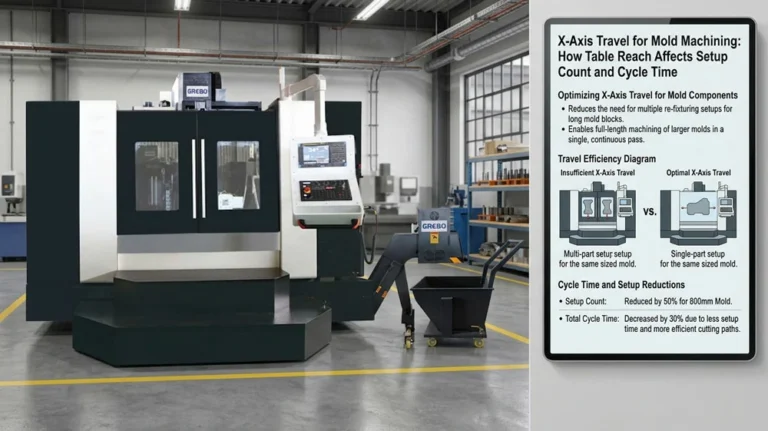
For workpieces too large to fit inside a C-frame VMC or HMC, a gantry machining center moves the spindle across a fixed bed instead of moving the part. The double-column bridge structure absorbs heavy cutting loads with minimal deflection, which is why gantry mills show up wherever mold bases and large structural components are made.
Tapping Centers and CNC Lathes
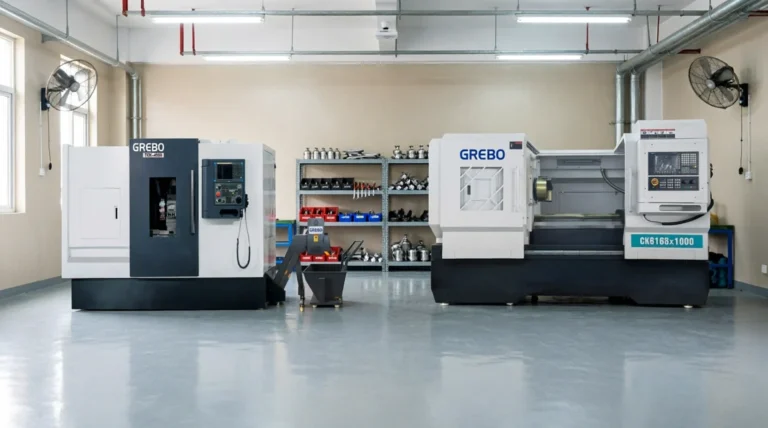
Not every job needs full milling capability. High-volume hole-tapping and light drilling work is often better served — and better priced — on a dedicated tapping center. And for round parts, a CNC lathe is still the more efficient choice than trying to turn a feature on a milling platform. Within lathes, a flat bed CNC lathe suits heavier, larger-diameter work, while a slant bed CNC lathe gives better chip and coolant drainage for higher-speed production runs.
Side-by-Side Comparison
Once you’ve worked through the framework above, this table is a fast way to double check how to choose a CNC machining center against the five configurations at a glance.
| Configuration | Best For | Watch Out For | Relative Investment |
|---|---|---|---|
| Vertical (VMC) | Flat/prismatic parts, mixed job-shop work | Chip pooling in deep pockets | Low – Medium |
| Horizontal (HMC) | Multi-face box parts, high volume | Fixture and pallet cost | Medium – High |
| 5-Axis | Complex contours, undercuts, aerospace/medical | Programming skill required | High |
| Gantry | Oversized molds and structural parts | Floor space, crane access | Very High |
| CNC Lathe | Round, shaft, and flange parts | Not suited to prismatic geometry | Low – Medium |
How to Choose a CNC Machining Center for Your Industry
Industry context changes which specs actually matter. A few common patterns we see across buyers:
Specifications That Actually Move the Needle
Once you know the configuration, a handful of specs separate a machine that fits your work from one that fights it:
- Spindle taper and speed range — dictates rigidity for heavy cuts versus finish quality on high-speed work.
- Tool magazine capacity — fewer tool changes for complex parts means shorter cycle times and less wear on the ATC mechanism.
- Positioning and repeatability accuracy — this is where independent verification matters more than a manufacturer’s brochure number. Machines are typically benchmarked against internationally recognized ISO 230 geometric accuracy test procedures, so it’s fair to ask a supplier which test method their published figures come from.
- Connectivity and monitoring — real-time spindle load and tool-wear data increasingly separates modern smart manufacturing-ready machines from older standalone units, particularly if unattended or lights-out operation is on your roadmap.
Pre-Purchase Checklist
Use this as the last gut-check on how to choose a CNC machining center before a purchase order goes out.
- Part drawings and tolerance requirements reviewed against machine specs, not just floor sample photos
- Floor plan checked for crane access, electrical service, and coolant/chip handling
- Control platform matches what your programmers and operators already run
- Spare parts lead time and local service response confirmed in writing
- Warranty terms and installation/training scope clearly defined before signing
- Reference customers in a comparable industry contacted directly
Common Mistakes Buyers Make
Most buyers already understand the theory of how to choose a CNC machining center, yet the same handful of errors show up again and again. Buying the highest axis count available “to be safe” instead of matching axes to actual part geometry wastes capital that could go toward tooling or a second machine. Skipping the floor survey until after the machine ships leads to expensive rework on foundations and electrical service. And choosing a supplier purely on unit price, without checking spare parts availability or applications support, tends to cost more over a five-year ownership window than the sticker price ever suggested — a mistake that’s easy to make when comparing quotes from an unfamiliar CNC machining center manufacturer in China without asking the right questions first.
Still Weighing Your Options?
If you’re still not sure how to choose a CNC machining center for your specific parts, that’s normal — the right configuration usually only becomes obvious once someone reviews your actual drawings. As a CNC machining center manufacturer in China, we work directly with buyers on machining solutions across automotive, mold, medical, and energy applications — happy to look at your parts and talk through fit before you commit to a spec sheet.
Talk to Our TeamFrequently Asked Questions
What’s the fastest way to learn how to choose a CNC machining center?
Work through the 5-step framework above in order — part geometry, volume, floor space, control system, then manufacturer — before comparing spec sheets. Buyers who start with specs instead of geometry are the ones who end up with the wrong machine.
What’s the real difference between a VMC and an HMC?
Spindle orientation drives everything else. A VMC’s vertical spindle gives easier setup and a lower price; an HMC’s horizontal spindle clears chips by gravity and, with tombstone fixturing, machines multiple faces in one clamping — which is why HMCs dominate high-volume, multi-sided parts.
Is a 5-axis machine worth it for a smaller shop?
Only if your part mix genuinely needs it. If most of your work is flat or single-face, a 3-axis VMC will out-earn a 5-axis machine on cost-per-part. If you’re regularly turning away complex-contour work, the reduced setups usually pay back the premium.
How much floor space should I budget beyond the machine footprint?
Leave room for chip conveyors, coolant tanks, dust or mist collection, and a clear service access path on at least one side of the machine — these routinely add 30-50% to the footprint shown in a spec sheet.
What should I ask a CNC machining center manufacturer before ordering?
Ask for spare parts lead times in writing, the location of the nearest service technician, reference customers in your industry, and which ISO 230 test method backs up their published accuracy figures. Vague answers to any of these are worth treating as a warning sign.
Is it worth sourcing from a CNC machining center manufacturer in China?
For most part families, yes — landed cost and lead time are usually competitive once freight is factored in, and certified factories routinely meet ISO 9001 and export documentation standards. The key is verifying certifications, requesting sample parts or a factory video call, and confirming OEM customization and after-sales support before placing a large order rather than after.