

Tapping Center vs VMC for Small Parts: Cycle Time & Batch Throughput Guide
A 15-horsepower vertical machining center with a 40-taper spindle looks more capable on paper than a compact tapping center with a 5.5kW motor and a BT-30 taper. On a single heavy cut, the VMC wins. On a batch of gearbox covers needing twenty M6 tapped holes each, the VMC often loses by a wide margin. The gap is not in cutting power. It is in mechanical delays: tool changes, rapid moves, and acceleration that repeat on every part.
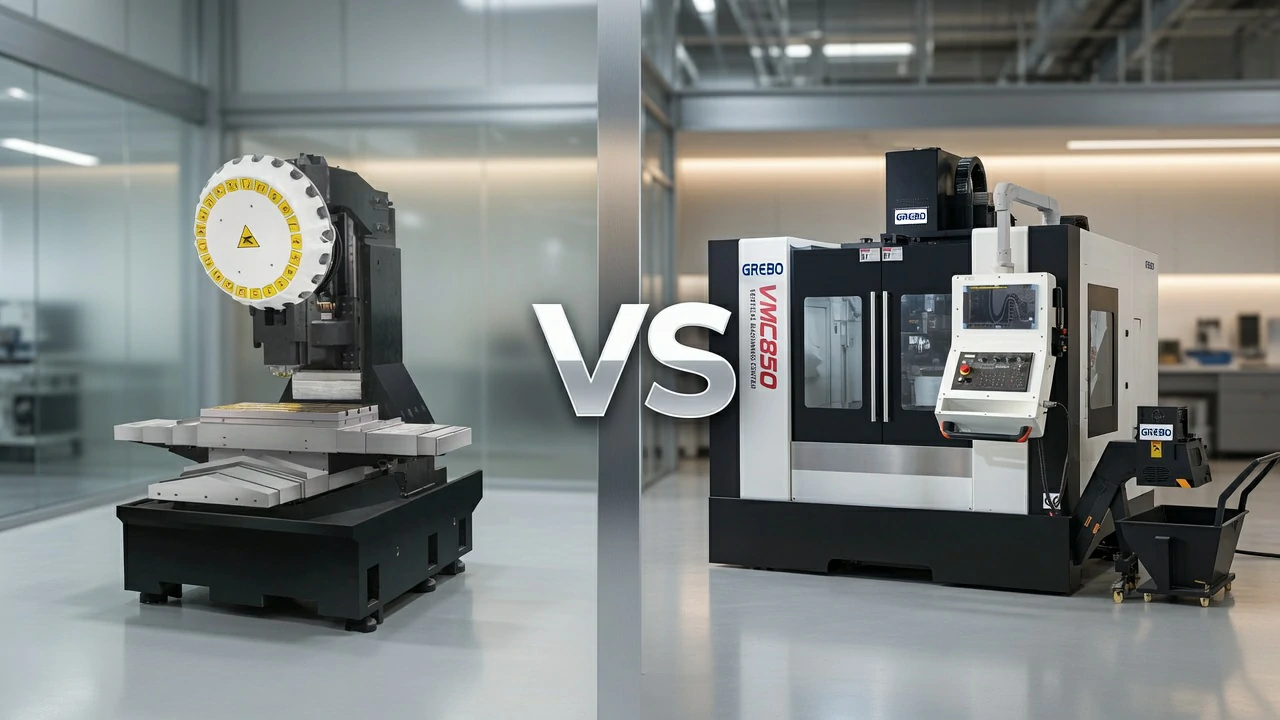
This article compares tapping center vs machining center for small parts production, focusing on the physical differences that actually control batch throughput. Based on typical production scenarios, you will learn why a specialized tapping platform can cut per-part cycle time by 30 to 50 percent on hole-heavy work, and when this approach delivers real ROI.
Table of Contents
- Tapping Center vs VMC for Small Parts: Cycle Time & Batch Throughput Guide
- The Hidden Gap: Why Most Comparisons Miss the Real Bottleneck
- Technical Deep Dive: Tool Change Speed, Rapid Feed, and Spindle Taper
- Real-World Application: Housing Parts and Batch Production Data
- Common Mistakes When Choosing Between Tapping Center and VMC
- FAQ: Tapping Center vs Machining Center
- Related Reading
The Hidden Gap: Why Most Comparisons Miss the Real Bottleneck
Most articles comparing tapping centers and VMCs focus on spindle speed, worktable size, and purchase price. These numbers are easy to list and easy to read. They are also the wrong place to start if your job is a batch of small parts with many holes.
The real bottleneck on hole-heavy work is non-cutting time. On a typical housing part with fifteen to twenty-five drilled and tapped holes, the actual metal removal takes less than 30 percent of the total cycle. The rest is tool changes, rapid positioning, and spindle acceleration. A VMC with a 2.5-second tool change and 36m/min rapid feed loses 40 to 60 seconds per part to these moves. A high-speed tapping platform with a 1.6-second tool change and 48m/min rapid feed recovers most of that time. Across a 500-part batch, the difference is not marginal—it typically translates to 20-30 minutes of saved machine time.
Industry data note: These cycle time estimates are based on standard machine tool specifications and typical hole patterns in automotive housing components. Actual results vary based on part geometry, material, and CAM programming optimization.
Competitor content rarely quantifies this gap. They write “tapping centers are faster” without explaining that the speed comes from the tool changer and the rapid feed, not from the spindle RPM alone. They also rarely mention that this advantage collapses on parts needing heavy milling or large stock removal. A tapping center is not a smaller, cheaper VMC. It is a different machine built around a different load case.
Technical Deep Dive: Tool Change Speed, Rapid Feed, and Spindle Taper
The mechanical differences between a tapping center and a VMC are not about power. They are about how each machine manages the repetitive, high-frequency moves that dominate small parts CNC drilling and tapping cycle time.
Tool Change Architecture
A VMC typically uses a servo-driven arm-type tool changer with a chip-to-chip time of 2.5 to 7 seconds. A tapping center uses a compact servo or cam-driven changer optimized for sub-2-second swaps. On a twenty-hole part requiring five tools, that difference compounds quickly.
The 21-pocket magazine on a compact tapping platform matches the tool count needed for typical housing part sequences: center drill, drill, tap, chamfer, and occasionally a reamer. A VMC may carry 24 or 30 tools, but the extra capacity is unused on small-part batches and adds mechanical mass that slows the changer.
Rapid Feed and Acceleration
VMC rapid feed rates typically range from 30 to 48m/min, but the machine mass limits acceleration. A tapping center with a lighter moving column reaches 48m/min on X and Y with faster acceleration curves. Between two holes 80mm apart, the tapping center reaches target speed sooner and decelerates faster. Over a full part program, these fractions of a second accumulate into meaningful throughput gains.
Spindle Taper and Torque Trade-Off
The BT-30 taper on most tapping centers is smaller and lighter than the BT-40 or CAT-40 on a VMC. It transmits less torque, which rules out heavy roughing. It also spins faster with less rotational inertia, supporting the 10,000 to 20,000rpm range where small drills and taps operate efficiently. The 5.5/7.5kW motor on a tapping center is sized for intermittent drilling and tapping, not continuous heavy cutting. That is a limitation, not a flaw: the motor is matched to the duty cycle of the work.
| Feature | Tapping Center (BT-30) | VMC (BT-40) |
|---|---|---|
| Typical Tool Change Time | 1.2 – 2.0 seconds | 2.5 – 7.0 seconds |
| Rapid Feed (X/Y) | 48 – 80 m/min | 30 – 48 m/min |
| Spindle Speed Range | 10,000 – 20,000 rpm | 8,000 – 15,000 rpm |
| Spindle Motor Power | 3.7 – 7.5 kW | 7.5 – 22 kW |
| Worktable Load | 150 – 400 kg | 500 – 2,000 kg |
| Best Application | Hole-heavy small parts, batch production | Heavy milling, large parts, mixed operations |
Real-World Application: Housing Parts and Batch Production Data
The tapping center advantage is most visible on parts where hole-making dominates the cycle and batch size justifies setup time. Gearbox covers with sixteen bolt holes, pump housings with multiple port threads, and valve bodies with several connection points are typical examples. When evaluating how to choose tapping center for housing parts, buyers must look beyond basic dimensions and focus on tool change architecture and rapid feed rates. A suitable compact tapping center with an 800 x 420mm worktable and 250kg load capacity handles these components within its envelope while keeping mechanical delays low.
Real application example: In an automotive component factory observed during a production audit, switching from a BT-40 VMC to a BT-30 tapping center reduced cycle time from 185 seconds to 115 seconds per part on a 500-piece batch of gearbox covers. The 38% reduction came almost entirely from faster tool changes and shorter positioning moves, not from cutting parameters.
Automotive bracket production is another clear fit. A mounting bracket may need six to ten M6 or M8 threads plus clearance holes. The part is small, the tool sequence is repetitive, and the batch runs into thousands. On this job, the 1.6-second tool change and 48m/min rapid feed translate directly into parts-per-hour output. The same bracket on a VMC spends proportionally more time in tool changes and positioning, so the per-part cost rises even though the VMC has more spindle power.
There are boundaries. A housing part needing a 20mm deep pocket milled before tapping should not go on a tapping center. The BT-30 taper and lighter frame lack the rigidity for deep slotting or heavy face milling. For mixed operations requiring significant stock removal before hole-making, a vertical machining center is the better starting point. The honest limit is part of the selection logic: match the machine to the dominant operation, not to the most demanding operation.
Common Mistakes When Choosing Between Tapping Center and VMC
Buyers evaluating small parts CNC drilling and tapping cycle time often make three predictable errors that cost money after the machine is installed.
Mistake 1: Buying Spindle Power Instead of Tool Change Speed
A 15kW spindle looks impressive on a specification sheet. On a hole-heavy part, it is mostly idle. The motor runs at low load during drilling and tapping, while the tool changer and rapid feed determine the cycle. A buyer who pays for horsepower they do not use, while ignoring the tool change time they do use, ends up with a machine that is over-specified for the actual bottleneck.
Mistake 2: Ignoring Batch Size in the ROI Calculation
A tapping center saves time per part, but the savings only matter at volume. For a prototype shop running five parts per setup, a 30-second cycle reduction is irrelevant. For a production shop running 500 parts, it is the difference between one shift and two. Buyers should calculate break-even batch size before deciding: below roughly 50 parts per setup, the VMC’s versatility often outweighs the tapping center’s speed advantage.
Mistake 3: Assuming a Tapping Center Can Replace a VMC for All Small Parts
A tapping center is not a smaller VMC. It is a specialized machine for a specific load case. Parts needing heavy milling, large face cuts, or aggressive roughing before finishing will stall on a tapping center. The BT-30 taper, lighter frame, and smaller motor are design choices that enable speed, not limitations that can be overcome with careful programming. Buyers who try to stretch a tapping center beyond its intended range end up with poor surface finish, excessive tool wear, and missed deadlines.
FAQ: Tapping Center vs Machining Center
When does a tapping center outperform a VMC on small parts?
A tapping center outperforms a VMC when the part is dominated by drilled and tapped holes, the batch size is above roughly 50 parts, and non-cutting time is the real bottleneck. The faster tool change and higher rapid feed recover seconds on every part that a VMC spends in mechanical moves. On heavy milling or mixed operations, the VMC remains the better choice.
How do I calculate whether batch size justifies a tapping center?
Measure the non-cutting time on your current VMC for a representative part: tool changes, rapids, and spindle acceleration. Multiply by your typical batch size and your hourly machine rate. If the annual wasted hours exceed roughly 30 percent of a tapping center’s purchase price, the payback is usually under two years. For batches below 50 parts, the savings rarely justify the dedicated machine.
Can a tapping center handle housing parts with some light milling?
Yes, within limits. A BT-30 tapping center with a 12,000rpm spindle can manage light facing, chamfering, and small slotting operations. It is not designed for deep pocketing or heavy roughing. If a housing part needs more than 20 percent of its cycle in milling, a VMC or a compact machining center with BT-40 taper is the safer choice. Standard tapping center configurations are optimized for drilling and tapping sequences with incidental light milling.
What spindle taper should I choose for high-volume tapping work?
BT-30 is the standard for high-speed tapping centers. It is lighter than BT-40, which supports faster acceleration and deceleration, and it handles the torque loads of small-diameter drilling and tapping without issue. BT-40 adds rigidity and torque capacity that is useful for milling but unnecessary for hole-making. For pure tapping and drilling on parts under 300mm, BT-30 is the more efficient choice.
How does rigid tapping differ from tapping with a floating attachment?
Rigid tapping synchronizes spindle rotation and Z-axis feed through the CNC control, eliminating the need for a floating tap holder. The tap follows a programmed helical path with fixed pitch-to-RPM ratio. This produces more accurate thread depth and better surface finish than floating attachments, which compensate for minor synchronization errors by allowing axial float. Rigid tapping is standard on modern tapping centers and is essential for high-speed thread production.
What information should I provide to get a tapping center recommendation?
Provide the part drawing or a description of the hole pattern, including thread sizes, depths, and quantities per part. Include the typical batch size, material, and whether any milling is needed. Also state your current cycle time if you have one. These details help determine whether a high-speed rigid tapping machine for batch production matches your actual production profile, or whether a more versatile platform is the better starting point.
Related Reading
- Learn more about machine configurations optimized for high-speed hole-making in our machining center range.
- Automotive component suppliers facing similar batch production challenges can find application guidance on our automotive CNC machining page.
Selecting between a tapping center and a VMC requires matching the machine’s dominant operation to your actual part profile, not buying the most powerful spindle on the specification sheet.
Share your part drawing, batch size, and current cycle time. Our application engineers will provide a tailored cycle time analysis and recommend the optimal configuration for your production needs.
Request Technical Consultation