
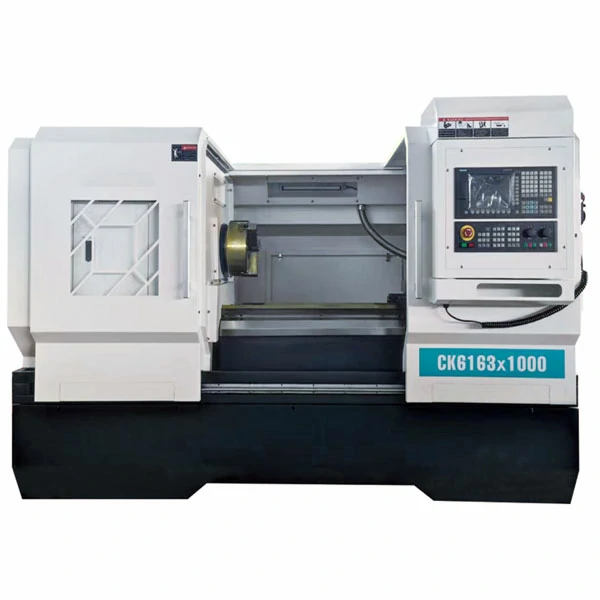
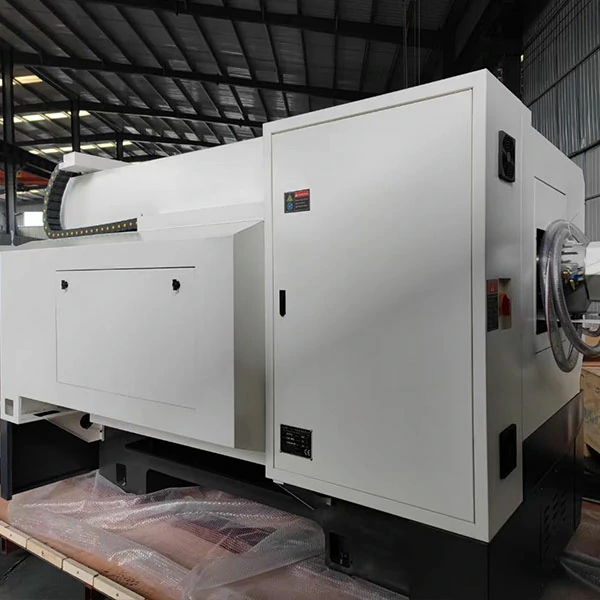
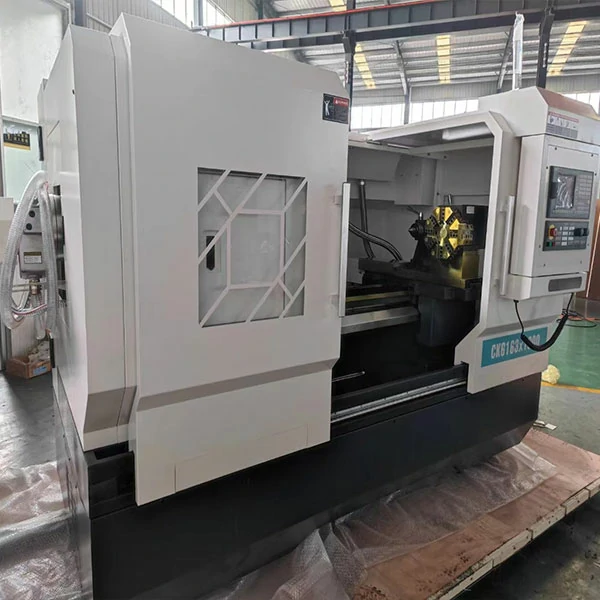

When machining large forgings, flanges, and heavy shafts, cutting stability matters more than acceleration. The CK series is designed around this principle: massive box ways, gearbox torque, and large spindle capacity.
Flat Bed CNC Lathe Key Features
Guideway width and ballscrew diameter scale with workpiece size. Choosing a CK model means matching the spindle bore and swing to your largest part, rather than just comparing frame prices.
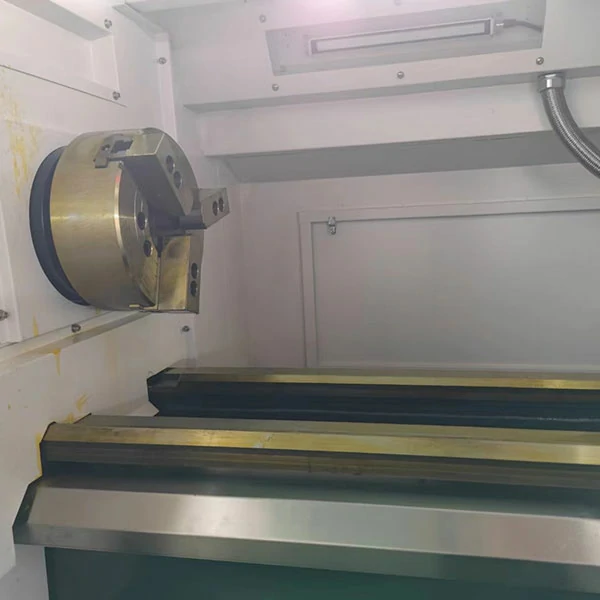
- A box-way guide structure ranging from 400mm to 755mm across the CK6150-CK61100 range absorbs vibration from interrupted cuts on cast or forged blanks, protecting the tool edge on hardened skin.
- The Z-axis ballscrew increases from Φ40x10mm on the CK6150/CK6163 to Φ80x16mm on the CK61100, providing the structural support to manage deflection and maintain feed rates under heavy roughing loads on long shafts.
- A spindle bore up to Φ125-130mm on the CK61100 allows bar stock to feed straight through the headstock, removing the need for secondary loading steps on long pipe and shaft work.
- The three-step gearbox spindle drops to 30-75 RPM on the CK61100 and 40-125 RPM on the CK6180, delivering the low-end torque needed for flange facing and thread cutting on tough alloys.
Engineering Insights
The right CK model in this range depends on part diameter and bore size, not price.
CK61100 tailstock specifications vary according to configuration. Confirm final tailstock dimensions based on the selected machine configuration before ordering.
A flat bed lathe is the wrong tool for automotive components, valve bodies, or small shafts requiring fast, high-finish cycles; a slant bed lathe from the TCK45 series is a better fit. However, for large forged shafts, flanges, or oil-country tubulars in single or small-batch runs, the CK6180 or CK61100 offers a clear advantage. Adding a hydraulic chuck is recommended once the part exceeds the capacity of a manual three-jaw chuck.
If choosing between CK6150/CK6163 and CK6180/CK61100, check swing diameter and spindle bore first: Φ500-630mm swing with Φ80mm bore covers mid-size shafts, while Φ800-1000mm swing with Φ100-125mm bore passes thick-wall pipe or bar stock through the headstock.
The standard 4-station toolpost lacks rigidity as cutting loads increase on larger models. The 6-station option provides the necessary tool capacity for heavy jobs.
Why Choose the CK Series Flat Bed CNC Lathe Over Slant Bed Alternatives?
Selecting the right machine depends on your specific workpiece demands. This comparison highlights why the CK Series is a specialized solution for extreme heavy-duty applications compared to standard or heavy-duty slant bed lathes.
| Comparison Criteria | TCK50xx Series Standard Slant Bed | TCK45xx Series Heavy-Duty Slant Bed | CK Series Flat Bed CNC Lathe |
|---|---|---|---|
| Core Application Focus | High-efficiency, high-precision batch production of medium-sized parts | High-rigidity heavy cutting and complex machining of large-diameter, medium-length shafts | Extreme heavy-duty cutting of extra-large diameters, extra-long shafts, and heavy castings/forgings |
| Bed & Guideway Design | Slant bed + 45mm linear guides | Slant bed + 55mm linear guides | Flat bed + 400-755mm ultra-wide box ways |
| Spindle Drive | Belt direct drive (high RPM) | Belt direct drive (medium-high RPM) | 3-step gearbox drive (ultra-low RPM, massive torque) |
| Max. Swing Diameter | Φ500 mm | Φ480 – Φ630 mm | Φ500 – Φ1000 mm (CNC Lathe for Large Diameter Turning) |
| Spindle Through-Hole | Φ66 mm | Φ87 mm | Φ82 – Φ130 mm (designed for heavy-wall tubing) |
| Typical Applications | Automotive drive shafts, small-to-medium hydraulic rods | Large-diameter hydraulic cylinders, complex flange shafts | Oil drill pipes, marine main shafts, large flanges, mill rolls (Heavy Duty CNC Lathe for Large Shafts) |
How to Select the Right CK Series Model
Selecting the correct model depends primarily on your maximum workpiece diameter and length requirements.
| Model | Recommended Application |
|---|---|
| CK6150 | Medium shafts and flange parts up to Φ500mm swing |
| CK6163 | Medium-large shafts requiring larger swing and bore capacity |
| CK6180 | Large flanges, mill rolls, and heavy shafts requiring high rigidity |
| CK61100 | Extra-large shafts, oilfield tubulars, and heavy forgings |
What Parts Can a Flat Bed CNC Lathe Machine?
Buyers often search for specific part capabilities rather than machine models. The CK series Flat Bed CNC Lathe is specifically engineered for:
- Large Shafts: Marine propulsion shafts, wind turbine main shafts, and heavy motor shafts.
- Flanges: Large-diameter pipe flanges, pressure vessel flanges, and structural connection plates.
- Oil Pipes & Tubulars: Drill pipe connections, casing, and oil country tubular goods (OCTG).
- Rolls: Mill rolls, printing rolls, and heavy industrial rollers.
- Forgings & Castings: Rough machining of uneven, heavy-walled, and large-diameter raw blanks.
Technical Specifications
The table below compares swing diameter, spindle bore, screw sizing, and tailstock capacity across all four models in this Flat Bed CNC Lathe series.
| Item | Unit | CK6150 | CK6163 | CK6180 | CK61100 |
|---|---|---|---|---|---|
| Max. swing over bed | mm | Φ500 | Φ630 | Φ800 | Φ1000 |
| Max. swing over cross slide | mm | Φ290 | Φ420 | Φ480 | Φ630 |
| Standard length options | mm | 500/1000/1500/2000/3000 | 500/1000/1500/2000/3000 | 750/1500/2000/3000 | 1500/2000/3000 |
| Max. bar diameter through spindle | mm | Φ80 | Φ80 | Φ100 | Φ125 |
| X axis travel | mm | 295 | 295 | 470 | 630 |
| Z axis travel | mm | approx. matches length option | approx. matches length option | approx. 600/1350/1850/2850 | approx. 1300/1800/2800 |
| Guide way width (box way) | mm | 400 | 400 | 600 | 755 |
| Spindle head model | – | A2-8 | A2-8 | C11 | A1-15 (or metric 120) |
| Spindle bore taper | – | Metric 90 (1:20) | Metric 90 (1:20) | Metric 120 (1:20) | Metric 120 (1:20) |
| Spindle bore diameter | mm | Φ82 | Φ82 | Φ105 | Φ130 |
| Spindle speed (3 steps) | rpm | 45-180 / 180-750 / 600-1600 | 45-180 / 180-750 / 600-1600 | 40-125 / 110-350 / 290-950 | 30-75 / 76-180 / 181-450 |
| X-axis screw (diameter x lead) | mm | Φ25 x 5 | Φ32 x 10 | Φ32 x 10 | Φ40 x 10 |
| Z-axis screw (diameter x lead) | mm | Φ40 x 10 | Φ40 x 10 | Φ63 x 10 | Φ80 x 16 |
| Tailstock sleeve diameter | mm | Φ75 | Φ75 | Φ100 | Φ120-140 |
| Tailstock sleeve travel | mm | 150 | 150 | 250 | 250 |
| Tailstock taper hole | – | MT5 | MT5 | MT6 | MT6 (or metric taper) |
| Weight (varies by length) | kg | 2400/2500/2700/3200/3800 | 2600/2700/2900/3400/4000 | 5000/5400/5700/6700 | 13500/15000/18000 |
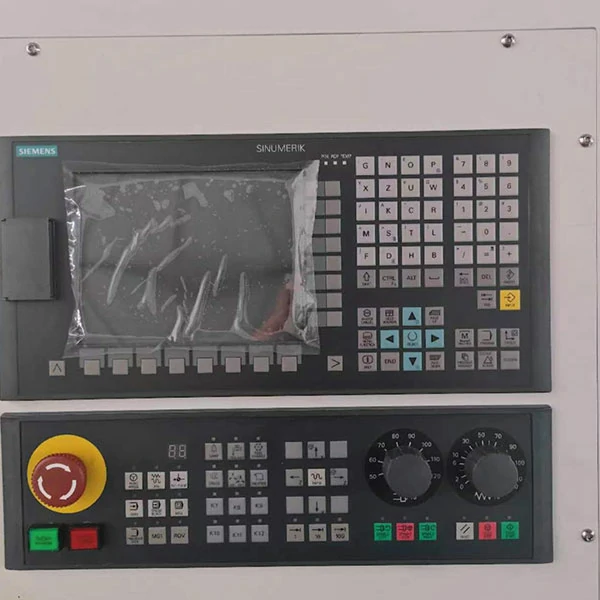
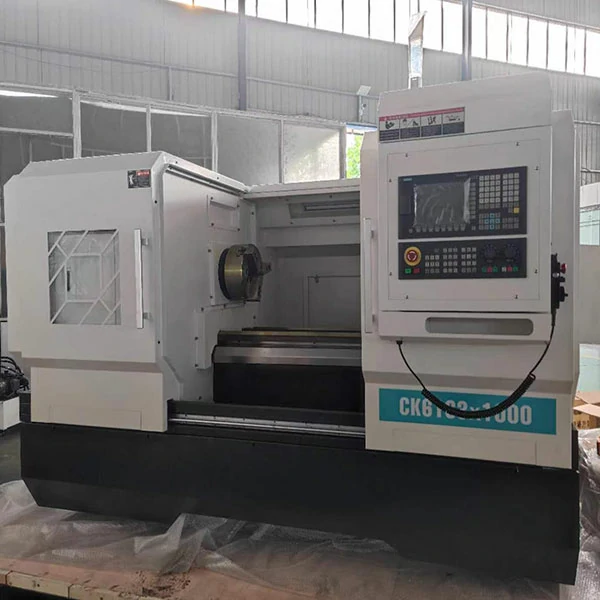
Standard control on this range is a FANUC 0i-TF system with semi-closed loop control on the X and Z axes.
Standard Configuration
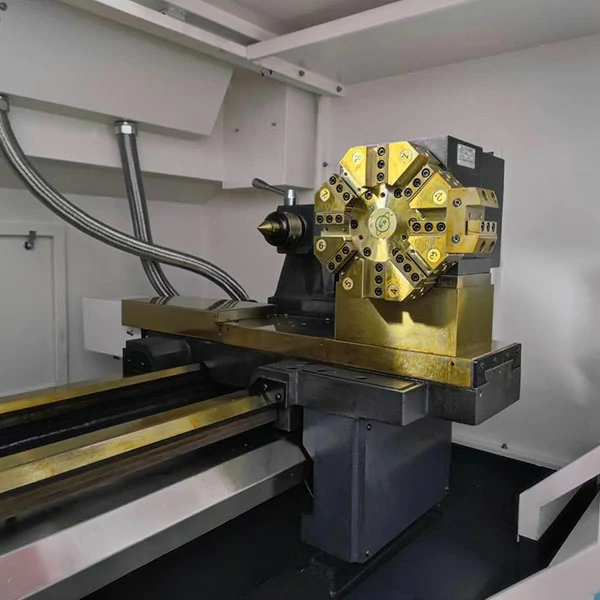
- FANUC 0i-TF control system
- 3-jaw chuck
- 4-station electrical toolpost
- Work lamp
- Coolant system
- Center sleeve
- Leveling blocks
- Full set of spanners
- Tool box
Optional Configuration
- 4-jaw chuck Φ250mm
- Pneumatic chuck Φ200mm
- Hydraulic chuck Φ200mm
- Hollow hydraulic chuck Φ200mm
- 6-station electrical toolpost
- Steady rest (center rest) for long shaft support
- Follow rest for continuous long-shaft turning
- Hydraulic tailstock
- Chip conveyor (screw or chain type)
- Full enclosure protection
Typical Application Cases
The scenarios below describe typical machining applications for this series based on its published parameters, rather than specific customer projects.
Marine and wind power shafts: long-shaft roughing between center and steady rest
Propulsion shafts and wind turbine main shafts typically run 1500-3000mm long at Φ300-600mm diameter, where many standard slant bed configurations may not provide the same low-speed roughing capability during heavy passes. As a heavy duty CNC lathe for large shafts, the CK6180/CK61100 maintains feed consistency across the full 3000mm length option. The Φ63-80mm Z-axis screw maintains feed consistency on long cuts.
- A sleeve diameter up to Φ120-140mm supports heavy center pressure on long, heavy blanks
- The 3000mm length option covers full-length shaft roughing in a single setup
- Minimizes the need for setup changes compared to shorter-bed alternatives for this shaft length range
Mining rolls and large flanges: interrupted cuts on uneven cast stock
Pipe flanges and mill rolls in the Φ600-1000mm range often carry uneven casting allowance and a hardened skin, turning roughing into a series of interrupted, shock-loaded cuts. Functioning as a CNC lathe for large-diameter turning, the CK6180/CK61100 combines a swing up to Φ800-1000mm with 600-755mm box ways, absorbing that impact rather than transmitting it into the slide.
- A Φ800-1000mm swing over bed accommodates large flange and roll diameters
- A 600-755mm box way width helps manage chatter risks on interrupted cuts
- Low-speed gearbox torque supports steady facing at large diameters without stalling
Oilfield tubulars: bar-fed threading without chatter at low RPM
Drill pipe connections and oil country tubular goods need stock fed straight through the spindle, which a bore under Φ90mm cannot handle. The CK6180/CK61100 spindle bore of Φ100-130mm passes this stock directly. The 40-125 RPM low gear range provides the torque needed for API thread cutting, helping to manage chatter risks.
- A Φ100-130mm spindle bore passes thick-wall tubular stock through the headstock
- A low gear range down to 30-40 RPM supports heavy-torque thread cutting
- Box way stiffness helps manage thread chatter risks at low speeds
FAQ
What is the difference between a flat bed lathe and a slant bed lathe?
A flat bed lathe uses a horizontal box-way bed that favors heavy, low-speed roughing on large or long parts, while a slant bed lathe angles the bed for faster chip clearance and higher-speed finishing. Flat bed machines like the CK series suit large shafts and flanges better than high-cycle small parts.
What is the typical spindle bore size for this lathe class, and why does it matter for bar work?
Spindle bore on this range runs from Φ82mm on CK6150/CK6163 up to Φ130mm on CK61100. A larger bore lets thicker bar stock or tubing pass through the headstock for through-feed work, which matters for long pipe and shaft parts that would otherwise need separate loading steps.
What tailstock and steady rest options apply to long slender shafts?
Tailstock sleeve diameter reaches up to Φ120-140mm on the CK61100 with 250mm of sleeve travel, giving strong center support on long, heavy shafts. A steady rest is a practical addition on the longest length options to control deflection during roughing passes.
How does bed rigidity affect surface finish on long shaft turning?
A wider box-way bed, up to 755mm on CK61100, resists bending under cutting force, which keeps the tool path steady along the full shaft length. Less bed deflection means fewer taper errors and a more consistent finish from one end of a long shaft to the other.
Need help matching a CK model to your shaft, flange, or bar-fed part? Our engineers can review your drawing and cutting requirements.
GREBO Machine Tool has been specializing in CNC machine tool manufacturing since 2005 in Tengzhou, Shandong, China. With ISO9001:2008 and CE certifications, our machines are exported to more than 50 countries worldwide.
Not every job calls for this bed style: for small automotive shafts, valve bodies, or high-cycle batch parts, a slant bed CNC lathe reaches finish quality faster than a flat bed machine built for heavy roughing. For structural and geometric accuracy references on this class of lathe, see ISO 13041-1:2020.