
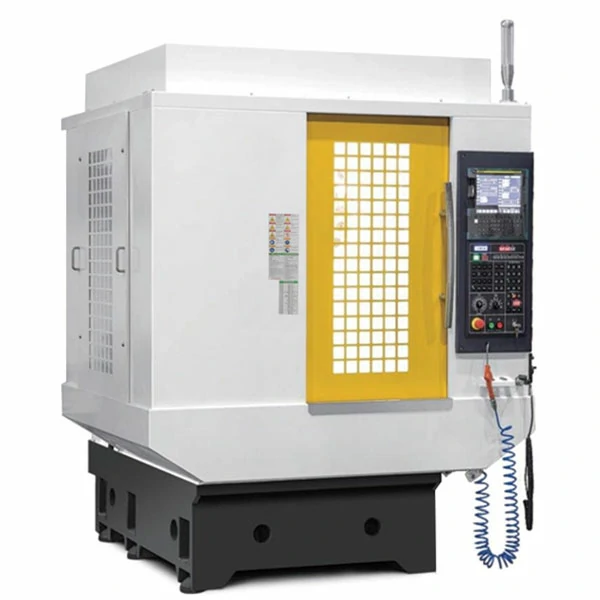
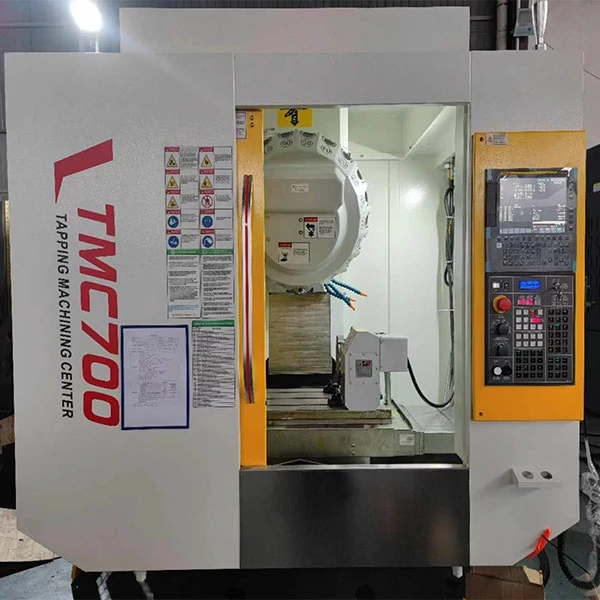
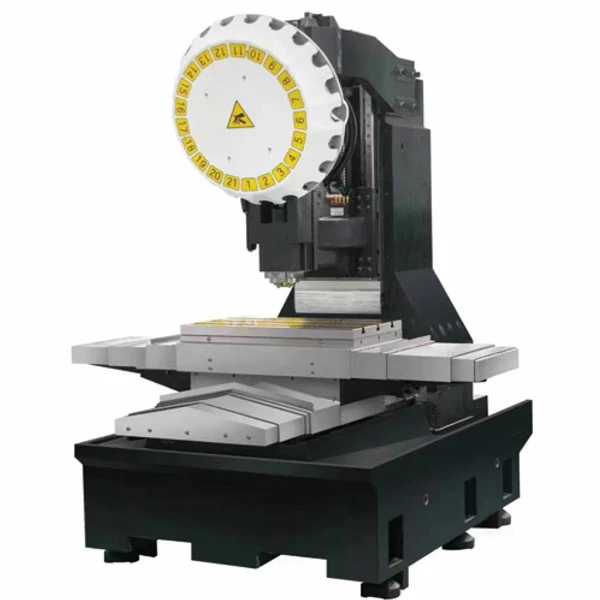
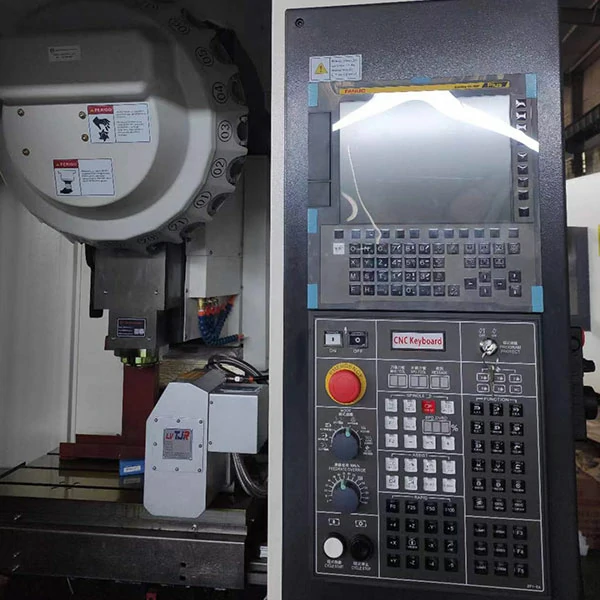
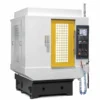
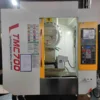
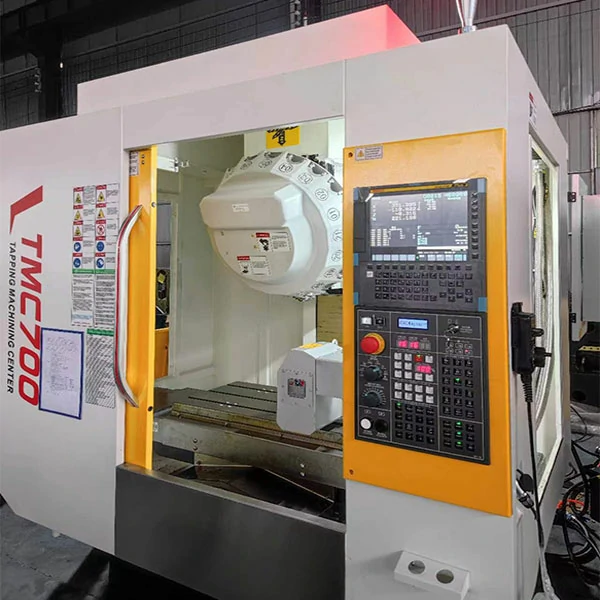
For small aluminum parts, productivity is often limited not by spindle power alone, but by positioning time and tool changes. The TMC600/TMC700 focuses on reducing these hidden cycle-time losses.
Built in an CE-certified facility, this tapping center line ships to over 50 markets through an exclusive agent network. If your workpieces require heavy milling or cast-iron machining beyond light aluminum drilling, a vertical machining center offers greater spindle torque and rigidity.
Key Features of This Tapping Center
This Tapping Center combines a 48 m/min rapid feed and a 1.6-second tool change to shrink non-cutting time well below conventional machining center cycles.
- The 48 m/min X/Y rapid feed minimizes positioning time on 700 mm worktables, keeping the spindle cutting rather than traveling between closely spaced holes.
- A 1.6-second tool-to-tool change with the 21T servo magazine slashes idle intervals compared to conventional ATC cycles, allowing batch volumes to scale without proportional cycle time growth.
- The BT30 direct-drive spindle delivers 12000 rpm and 5.5 kW continuous power, maintaining stable chip loads in aluminum drilling and tapping without belt-slip variation.
- Servo motors couple directly to precision ballscrews on all three axes, eliminating backlash and supporting the 0.005 mm repeat positioning accuracy that dense hole patterns demand.
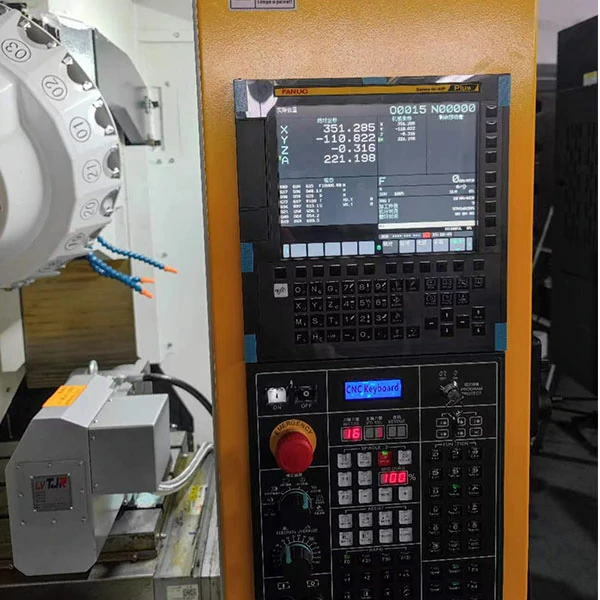
- Rigid tapping synchronizes spindle rotation with Z-axis feed via the FANUC 0i-MF Plus system, producing threads that meet Class 2B/6H tolerances without secondary reaming or hand finishing.
Why Choose a Tapping Center for Small Aluminum Parts?
- 1.6-second tool-to-tool change with a 21T servo magazine, well below typical belt-driven ATC cycles.
- 48 m/min X/Y rapid traverse keeps the spindle cutting rather than repositioning between closely spaced holes.
- Compact footprint compared with full-size VMCs, useful in space-constrained production lines.
- Lower spindle and servo power draw than heavier-duty machining centers, since the BT30 spindle and lighter axes require less continuous power.
- Suited to high-repetition drilling and tapping in aluminum and brass, where hole density and cycle time matter more than material removal rate.
Engineering Insights
High-speed drilling and tapping centers achieve productivity gains by minimizing mechanical delay between servo command and axis motion, not simply by raising spindle power.
Note: The TMC600 and TMC700 share identical Y/Z travel, spindle, and control specifications. The only meaningful difference is 100 mm of X-axis stroke and table length. Do not pay for extra stroke you will not use.
The 48 m/min rapid traverse on the X and Y axes pairs with a 1.6 s tool change because the servo-driven magazine and direct-coupled ballscrews eliminate mechanical delays common in belt-driven ATCs. This direct mechanical coupling measurably drops batch cycle times, though actual cycle-time improvement depends on part geometry, fixture design, and tool path strategy.
If your aluminum parts stay under 500 mm and you clamp one or two pieces per setup, the TMC600 keeps the footprint compact and capital costs lower. If you run 500–650 mm brackets or array four small housings on one fixture, the TMC700’s extra 100 mm of X travel avoids a second fixture. This often recovers the price difference within a single production quarter through reduced loading labor.
For smaller high-speed parts that do not need a dedicated 21T tapping magazine, our high-speed vertical machining center line covers 650–850 mm tables. Repeat positioning holds 0.005 mm under ISO 230-2:2014 measurement protocols.
Technical Specifications
The following table lists verified parameters for the TMC600 and TMC700, including axis travel, spindle data, feed rates, and accuracy grades under ISO 230-2 test conditions.
Recommended Workpiece Materials
- Aluminum alloy: Housing, brackets, heat sinks
- Brass: Connectors, fittings
| Parameter | Unit | TMC600 | TMC700 |
|---|---|---|---|
| X / Y / Z Axis Travel | mm | 600 / 400 / 300 | 700 / 400 / 300 |
| Spindle Nose to Worktable | mm | 150 – 450 | 150 – 450 |
| Spindle Center to Column | mm | 460 | 460 |
| Worktable Size | mm | 700 × 420 | 800 × 420 |
| Max. Worktable Loading | kg | 250 | 250 |
| T-Slot (No. × Width × Pitch) | – | 3 × 14 × 125 | 3 × 14 × 125 |
| Spindle Taper | – | BT-30 | BT-30 |
| Spindle Transmission | – | Direct Drive | Direct Drive |
| Spindle Speed | rpm | 12000 | 12000 |
| Spindle Motor Power | kW | 5.5 / 7.5 (Continuous / Peak) | 5.5 / 7.5 (Continuous / Peak) |
| Three-Axis Transmission | – | Servo Direct-Coupled Ball Screw | Servo Direct-Coupled Ball Screw |
| X / Y / Z Rapid Feed | m/min | 48 / 48 / 36 | 48 / 48 / 36 |
| Cutting Feed Speed | mm/min | 1 – 20000 | 1 – 20000 |
| Tool Magazine Capacity and Type | pcs | 21T Servo Umbrella Type | 21T Servo Umbrella Type |
| Tool Change Time (T-T) | sec | 1.6 | 1.6 |
| Positioning Accuracy | mm | 0.008 | 0.008 |
| Repeat Positioning Accuracy | mm | 0.005 | 0.005 |
| Overall Dimensions (L × W × H) | mm | 2300 × 1900 × 2200 | 2400 × 1900 × 2200 |
| Machine Weight | kg | 3000 | 3200 |
Standard Configuration
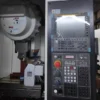
Every TMC600 and TMC700 ships with FANUC 0i-MF Plus control, a direct-drive BT30 spindle, servo-coupled ballscrews, and a 21T servo tool magazine as baseline equipment.
- FANUC 0i-MF Plus CNC system with USB program transfer
- X/Y/Z FANUC servo motors and drives
- FANUC spindle motor
- Taiwan-brand BT30 direct-drive spindle, 12000 rpm
- Taiwan-brand precision ball linear guideways on three axes
- Taiwan-brand precision ball lead screws
- 21T servo umbrella-type tool magazine
- Rigid tapping function
- Air through spindle (ATS)
- Centralized automatic lubrication
- Fully enclosed sheet-metal cover
- Stainless telescopic covers on three-axis guideways
- Coolant system
- Electrical cabinet heat exchanger
- Safety door interlock
- Work light and three-color alarm lamp
- Manual pulse generator (MPG)
- High-pressure air gun and coolant gun
- Leveling blocks and anchor bolts
- Bilingual user manual
Typical Application Cases
These three scenarios illustrate how the TMC series performs in verified batch production environments where hole density, thread quality, and cycle time drive purchasing decisions.
Application: Aluminum Electronics Housing Batch Production
Typical applications include tablet frames and phone mid-plates in 6061-T6 aluminum, which require dozens of M1.6–M3 threaded holes and shallow pockets. Conventional VMCs lose minutes to slow ATC and conservative rapid feeds. The TMC700 maintains 48 m/min traverse and 1.6 s tool changes under continuous FANUC servo control, sharply dropping non-cutting time. Depending on part geometry and process optimization, cycle time reductions of 25–40% may be achievable in suitable applications compared with conventional VMC operations.
Application: Automotive Sensor and Connector Housing Machining
Automotive sensor housings and ECU brackets in die-cast aluminum demand repeatable M3–M6 threads across thousands of pieces. Small taps break easily when chip evacuation fails or feed synchronization drifts. The TMC600/700 runs rigid tapping with ATS air-through-spindle flushing and a 21T servo magazine, completing drilling, reaming, tapping, and chamfering in one setup. In these applications, manufacturers often achieve improved machining efficiency through reduced setup and tool-change time.
Application: Dense Hole Pattern Machining on Communication Heat Sinks
Communication heat sinks and multi-port valve bodies contain arrayed hole systems where positioning and tool exchange can occupy over 70% of the total cycle time. Blind-hole tapping also risks thread damage or tap breakage from poor chip clearance. The TMC series sustains 48 m/min rapid positioning across the full stroke, while centralized auto-lubrication and stainless telescopic covers protect guideways during high-frequency start-stop cycles. Repeat positioning holds 0.005 mm, which helps maintain consistent thread quality during long-run production.
Frequently Asked Questions
The answers below cover core differences between tapping centers and general VMCs, rigid tapping mechanics, magazine capacity, and high-speed spindle maintenance intervals.
What is the difference between a tapping center and a full VMC?
A tapping center optimizes rapid traverse, tool change speed, and spindle acceleration for small-hole drilling and tapping in aluminum and brass. A full VMC trades some of that speed for heavier cutting torque, larger work envelopes, and roughing capacity in steel or cast iron. Choose a tapping center when batch cycle time and hole density matter more than material removal rate.
How does rigid tapping improve thread quality on small-diameter holes?
Rigid tapping locks spindle rotation to Z-axis feed through closed-loop servo synchronization. This eliminates the float-induced pitch error and tap drift common in tension-compression holders, ensuring M3–M6 threads hold Class 2B/6H tolerances without secondary reaming or hand finishing.
What tool magazine capacity is typical for this tapping center class?
The 21T servo umbrella-type magazine stores drilling, tapping, reaming, and chamfering tools in one continuous setup. Its 1.6-second tool-to-tool change keeps non-cutting intervals minimal during batch production, allowing part counts to scale without proportional cycle growth on long runs.
What maintenance considerations are unique to high-speed tapping spindles?
Grease replenishment at the spindle bearing set, ATS air-line filter inspection, and cam wear checks on the servo magazine should occur every 500 operating hours. These steps prevent thermal drift, maintain 12000 rpm stability, and protect the direct-drive interface from coolant contamination in continuous batch environments.
Can a tapping center machine steel parts?
Yes, for light drilling and tapping operations. However, a tapping center is optimized for non-ferrous materials like aluminum and brass. For heavy milling or extensive steel machining, a full vertical machining center (VMC) with higher spindle torque and rigidity is recommended.
How do I choose between TMC600 and TMC700?
The TMC600 and TMC700 share identical Y/Z travel, spindle, and control specifications. The only meaningful difference is 100 mm of X-axis stroke and table length. Choose the TMC600 for parts under 500 mm to keep the footprint compact and capital costs lower. Choose the TMC700 if you run 500–650 mm brackets or need to array multiple small housings on one fixture, avoiding extra setups.