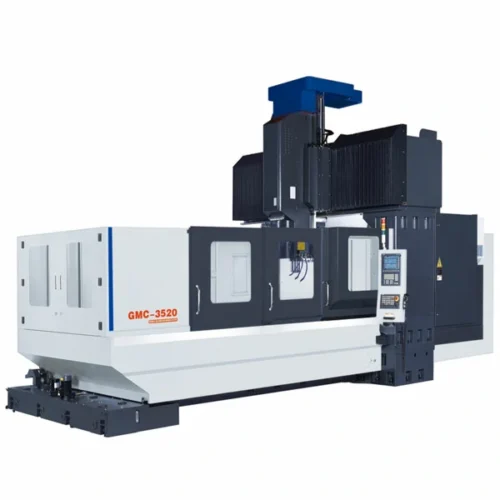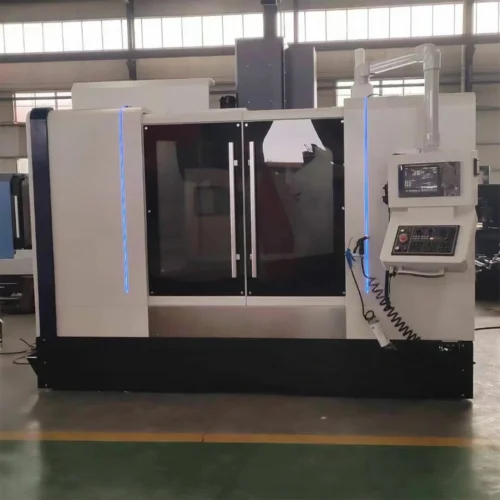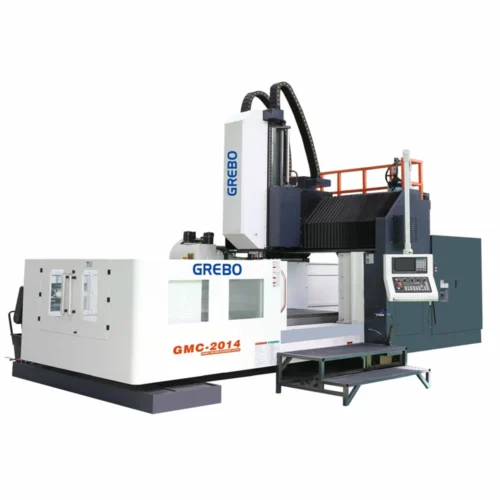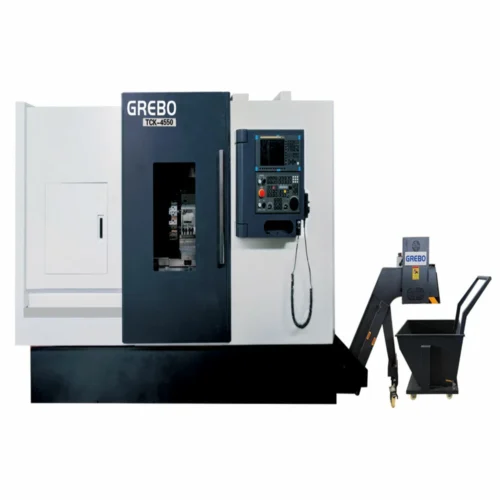

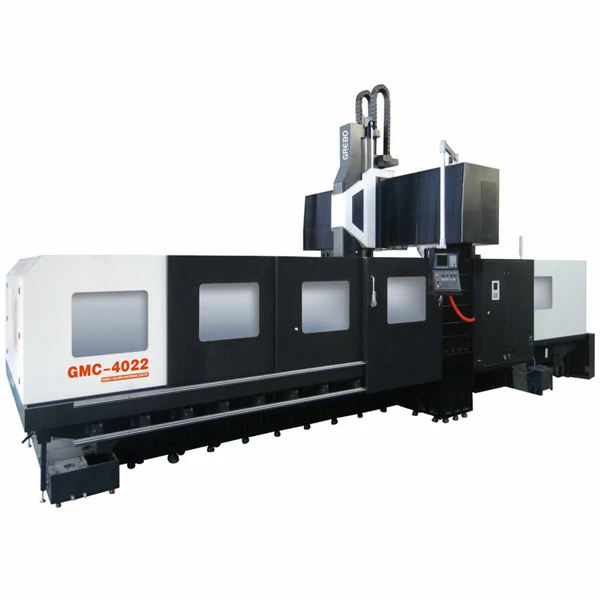
Since all three models share the same 22kW BT50 spindle, upgrading from a 3000mm to a 5000mm table provides additional reach and load capacity, not faster material removal rates. Buyers should match the machine size strictly to workpiece dimensions to avoid overpaying for unused horsepower.
Unlike standard gantry models with 2000mm spans, this series features a wider 2300mm column span and a Φ80/20 X-axis leadscrew designed for heavy, long-travel loads. The slide block count rises from 10 on the GMC3022 to 14 on the GMC4022 and GMC5022 to resist beam twist across these wider spans. Manufactured in a 28,000-square-meter ISO 9001:2015 and CE-certified facility, this series is exported to over 50 countries.

Bridge Type CNC Machining Center Key Features
- A fixed 2300mm column span combined with 55mm X/Y linear guides keeps the spindle centered across the full worktable, reducing lateral drift that can lead to surface steps or mismatch across wide panels.
- The X-axis leadscrew remains at Φ80/20 across all three models, which provides the stiffness needed to minimize deflection during long-travel heavy-load machining.
- The GMC3022 uses 10 slide blocks, while the GMC4022 and GMC5022 use 14. This adds critical support points along the beam to counter sagging as X-axis travel extends from 3000mm to 5000mm.
- The Z-axis box way maintains cutting rigidity through deep-cavity plunge cuts that a linear guide alone would struggle to support under heavy side-loading.
- Worktable capacity spans 10 to 14 tons, making this range a super large gantry machining center built specifically for wider, heavier shipyard, energy fabrication, and large mold base work.
Because spindle power remains constant, selecting a larger model strictly addresses workpiece length and tonnage limits. This makes the series a reliable choice for energy industry applications, such as machining large wind turbine hubs, where stability outweighs raw speed.
Technical Specifications
The technical specifications below cover the full GMC3022 to GMC5022 range, showing how travel, load capacity, and drive components scale across the series. Positioning and repeat accuracy values reference ISO 230-2:2014 test methods.
| Parameter | Unit | GMC3022 | GMC4022 | GMC5022 |
|---|---|---|---|---|
| X / Y / Z Axis Travel | mm | 3000 / 2200 / 1000 | 4000 / 2200 / 1000 | 5000 / 2200 / 1000 |
| Spindle Nose to Worktable | mm | 280 – 1280 | 280 – 1280 | 280 – 1280 |
| Distance Between Two Columns | mm | 2300 | 2300 | 2300 |
| Leadscrew Dia./Pitch (X) | mm | Φ80 / 20 | Φ80 / 20 | Φ80 / 20 |
| Leadscrew Dia./Pitch (Y) | mm | Φ63 / 12 | Φ63 / 12 | Φ63 / 12 |
| Leadscrew Dia./Pitch (Z) | mm | Φ50 / 10 | Φ50 / 10 | Φ50 / 10 |
| Guideway Type/Width (X/Y) | mm | 55mm Linear | 55mm Linear | 55mm Linear |
| Guideway Type (Z) | – | Box Way | Box Way | Box Way |
| Guide Block Qty (X / Y) | pcs | 10 / 4 | 14 / 4 | 14 / 4 |
| Worktable Size | mm | 3000 x 2000 | 4000 x 2000 | 5000 x 2000 |
| T-slot (Qty x Width x Pitch) | mm | 9 x 28 x 200 | 9 x 28 x 200 | 9 x 28 x 200 |
| Max Loading Capacity | Ton | 10 | 12 | 14 |
| Spindle Taper | – | BT50 | BT50 | BT50 |
| Spindle Transmission | – | Belt Drive | Belt Drive | Belt Drive |
| Spindle Speed | rpm | 6000 | 6000 | 6000 |
| Spindle Motor Power | kW | 22 | 22 | 22 |
| X / Y / Z Fast Moving Speed | m/min | 12 / 12 / 12 | 12 / 12 / 12 | 12 / 12 / 12 |
| Cutting Feed Speed | mm/min | 1 – 8000 | 1 – 8000 | 1 – 8000 |
| Tool Magazine Capacity and Type | pcs | 24, Disc | 24, Disc | 24, Disc |
| Positioning Accuracy | mm | 0.008 | 0.008 | 0.008 |
| Repeat Accuracy | mm | 0.005 | 0.005 | 0.005 |
| Machine Weight | kg | 28000 | 30000 | 34000 |
Engineering Insights: Choosing Between GMC3022, GMC4022, and GMC5022
Model selection within this bridge type CNC machining center range depends strictly on workpiece length and tonnage.
Engineer note: Upgrading to a larger model buys structural reach and load capacity, not faster material removal. Base your size selection on workpiece dimensions to avoid overpaying for unused capacity.
If a workpiece runs around 3000mm and stays under 10 tons, the GMC3022’s 10 slide blocks and Φ80 leadscrew meet the load requirements. However, if the part approaches 4000-5000mm or regularly exceeds 10 tons, the 14 slide blocks used on the GMC4022 and GMC5022 become a structural necessity. Fewer support points across that span would allow the beam to flex under heavy load.
Workpieces under roughly 3000mm or 10 tons won’t load this frame enough to justify its slide block count and leadscrew rating, so a gantry machining center in a smaller frame may be more cost-effective; projects exceeding 5000mm or 14 tons should instead look at the extra large gantry machining center range.
Standard Configuration
- Mitsubishi M80A controller with Mitsubishi servo motors and drivers on X/Y/Z axes
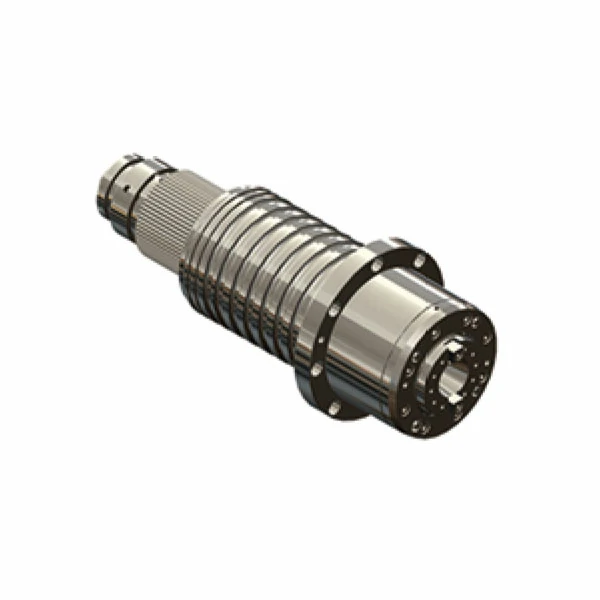
- Taiwan-brand spindle unit (e.g., Kenturn or Royal), belt drive, 6000 rpm max speed
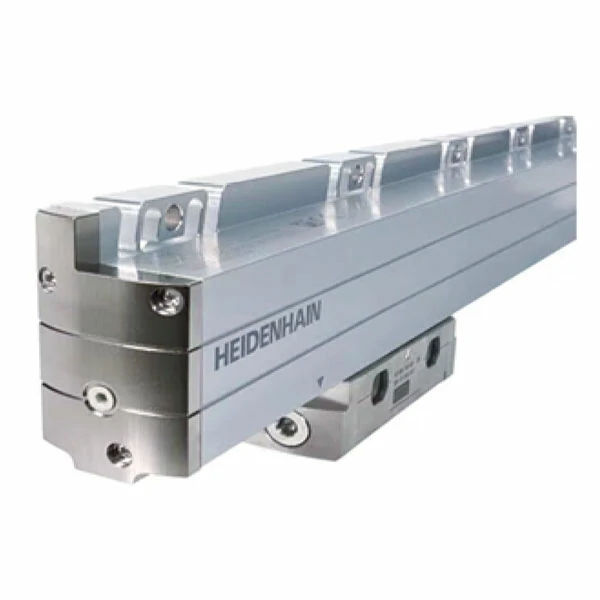
- Taiwan-brand 55mm precision linear guides on X/Y axes
- Box way on Z-axis for heavy cutting rigidity
- Taiwan-brand precision ball leadscrew
- Nitrogen balance cylinder on Z-axis spindle head
- 24-tool disc-type tool magazine
- Screw-type chip conveyor x 2
- Chain-type chip conveyor and chip bucket x 1
- Automatic centralized lubrication system
- Heat exchanger for electrical cabinet
- Air gun and water gun
- Levelling pads, nuts, and bolts
- Standard tools and tool box
Typical Machining Examples
Based on this configuration, typical machining examples for this bridge type CNC machining center include wind turbine hub milling and shipyard bulkhead machining, which require extended table sizes and consistent heavy-duty spindle power.
Typical Machining Example: Wind Power Hub and Nacelle Base Machining
Wind power hubs and nacelle bases in ductile iron or large alloy steel castings typically run 8-12 tons across a 3-4 meter footprint. Beam deflection on less rigid gantry structures can throw bearing bore alignment out of tolerance, especially across repeated flip-and-re-fixturing setups that introduce cumulative error. Running this class of part on the GMC4022 or GMC5022 supports bearing bore alignment in a single setup, since the 14 slide blocks and Φ80 leadscrew are designed for this class of load and span. The 22kW spindle supports continuous roughing on ductile iron or cast steel while maintaining stable cutting performance and minimizing chatter risk.
- The machine provides 0.008mm positioning accuracy according to ISO 230-2:2014 test methods, while its rigid structure supports heavy workpiece loading.
- A single setup can typically replace the multiple re-fixturing passes a lighter gantry would require on the same casting.
Typical Machining Example: Shipbuilding Bulkhead and Propeller Base Machining
Welded steel bulkhead sections and propeller bases for large vessels carry internal stress from welding and often exceed 10 tons across a 4-5 meter length. Flatness and hole-position accuracy directly affect how well dock sections align at final assembly, so repositioning mid-pass risks mismatch. The GMC5022’s 5000mm X-axis travel and Z-axis box way support a stable skim-cut pass across the full weld seam without repositioning. The dual screw and chain chip conveyor setup clears steel chips continuously across the full 2000mm table width during long runs.
- The machine’s positioning accuracy specification supports consistent machining alignment across long 5000mm passes.
- The dual chip conveyor system clears steel chips continuously during unattended overnight roughing.
- A single skim-cut setup can typically replace multiple shorter passes a smaller-table machine would require on the same panel.
Frequently Asked Questions
Common questions about this bridge type CNC machining center cover fixed-bridge advantages, deflection control, and application suitability.
What are the advantages of fixed-gantry design for large structural components and heavy mold bases?
A fixed dual-column frame converts lateral cutting forces into compression across the bridge rather than bending a single column, which keeps the spindle nose centered over the full worktable. That structural path helps maintain flatness and hole-position accuracy on large plates that a moving-column layout would struggle to hold steady across a multi-meter span.
Can gantry machining centers handle both roughing and precision finishing?
Within this series, the same BT50 setup supports heavy roughing passes on cast or welded workpieces and precision finishing operations with high positioning accuracy. Parts can move from stock removal to final tolerance in a single setup without a machine change between roughing and finishing operations.
How does the gantry structure handle cutting deflection toward the table ends?
Slide block count rises from 10 on the GMC3022 to 14 on the GMC4022 and GMC5022, adding support points along the beam. That layout distributes the spindle head mass so it resists torsional deflection as it travels toward the far end of a 4000-5000mm span under heavy cutting load.
What industries most commonly use gantry machining centers?
This size class most commonly serves wind power component manufacturing, shipbuilding, and heavy energy equipment fabrication, where castings and welded structures regularly exceed 8 tons. These industries require single-setup machining across a wide, stable worktable that resists deflection under concentrated loads.
For sizing guidance or a quotation for your heavy structural machining project, contact our engineering team directly.